Understanding Knee Replacement Success Rates: A Surgeon’s Perspective After 12,000+ Surgeries

When patients search for the knee replacement surgery success rate, they usually want to know one thing: How likely is the surgery to give me a good result? The answer is generally positive, but success cannot be judged by one number alone. The outcome depends on the condition of the knee, the timing of surgery, surgical planning, implant positioning, the surgeon’s experience, and rehabilitation.
Dr. S. Arumugam brings more than 27 years of surgical experience to knee replacement care. His profile records 12,000+ surgeries, more than 8,000 joint replacements and 1,000+ robotic knee replacement procedures. He is also involved in academic teaching and mentoring for robotic knee replacement techniques.
What Is the Knee Replacement Surgery Success Rate?
There is no single knee replacement surgery success rate that applies to every patient. Modern knee replacement has strong long-term outcomes, but success can mean different things to different people.
For one patient, success may mean significant reduction in arthritis-related pain. For another, it may mean better knee movement, stability, or the ability to return to routine activities.
Long-term implant survival is another important measure. Registry data show that several total knee replacement constructs have cumulative revision rates below 2.2% at 10 years among older patients with primary osteoarthritis.
Therefore, the knee replacement surgery success rate should be understood as a combination of implant survival, functional improvement, patient satisfaction, and recovery.
What Influences the Knee Replacement Surgery Success Rate?
The knee replacement surgery success rate is influenced by several factors.
1. Correct Patient Selection
Knee replacement is not recommended simply because an X-ray shows arthritis. The surgeon considers symptoms, joint damage, movement, deformity, previous treatments, age, activity level and overall health.
Surgery is generally considered when advanced knee damage causes significant symptoms and conservative treatments are no longer providing adequate relief.
2. Accurate Surgical Planning
Precise planning plays an important role in the knee replacement surgery success rate. The surgeon needs to assess the knee’s anatomy, alignment, bone condition and ligament balance before selecting the appropriate implant and surgical approach.
During surgery, accurate positioning of the implant components is essential for proper joint function.
3. Surgeon Experience
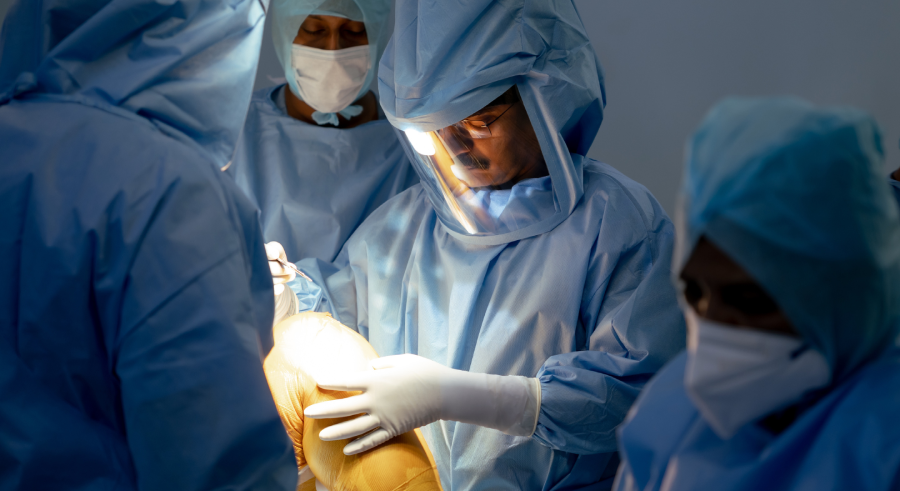
Technology can assist surgery, but it does not replace clinical judgment. An experienced knee replacement surgeon understands how to adapt the procedure when anatomy, deformity or ligament condition differs from the standard case.
Dr. Arumugam has completed more than 8,000 joint replacement procedures and 1,000+ robotic knee replacements. His profile also notes his role as senior faculty and mentor for robotic knee replacement techniques in India and Southeast Asia.
This experience is an important consideration when evaluating the knee replacement surgery success rate for an individual patient.
Does Robotic Surgery Improve the Knee Replacement Surgery Success Rate?
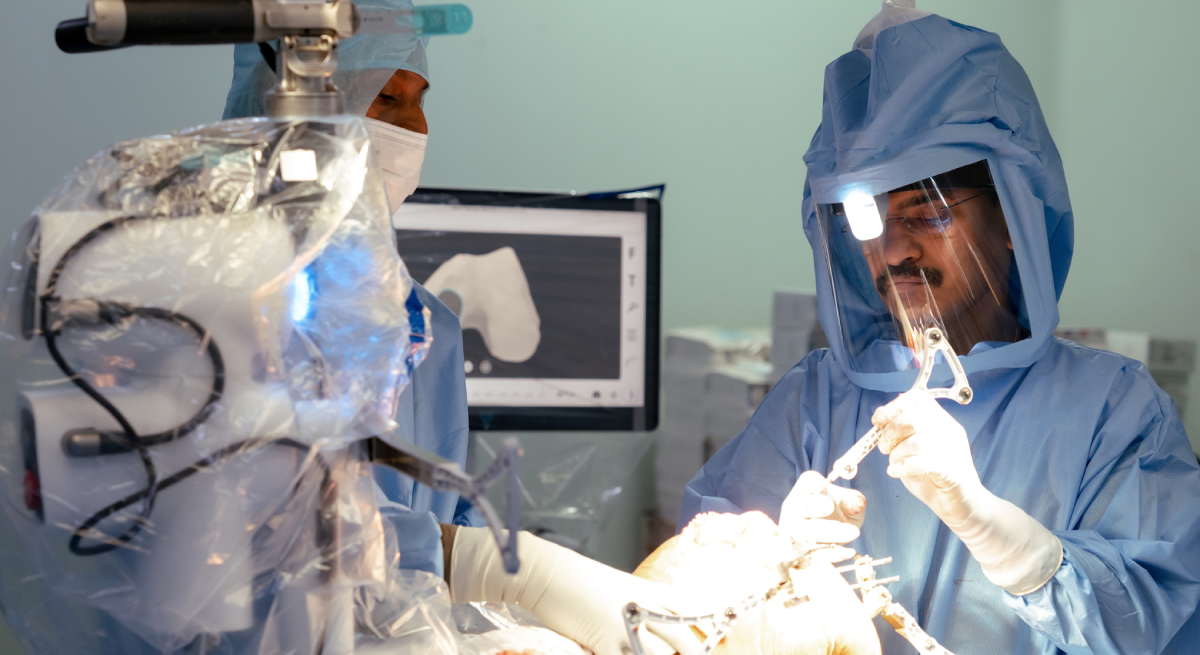
Robotic-assisted knee replacement provides additional tools for surgical planning and precision. It can help the surgeon assess alignment, prepare the bone and position the implant according to the planned parameters.
However, robotic technology does not guarantee a particular knee replacement surgery success rate.
The surgeon remains responsible for patient selection, surgical decisions, implant choice and execution. In other words, robotics is a tool that supports the surgeon rather than replacing surgical expertise.
Dr. Arumugam is among the early orthopaedic surgeons in Chennai to perform robotic knee replacement using the VELYS Robotic-Assisted Solution. His profile also records extensive academic involvement in robotic knee replacement.
Dr. Arumugam’s Approach to Knee Replacement
Dr. Arumugam’s surgical experience extends beyond robotic technology. He has performed knee replacement without a tourniquet since 2003, a technique he adopted long before robotic-assisted procedures became widely used.
His approach combines surgical experience, careful tissue handling and the appropriate use of technology. He has also participated in academic robotic knee replacement programs and live surgical demonstrations, sharing his experience with other orthopaedic professionals.
For patients, this highlights an important point: the knee replacement surgery success rate depends on the complete treatment process, not simply the use of a robotic system.
What Can Affect Knee Replacement Outcomes?
Several patient-related factors can influence the knee replacement surgery success rate, including:
- Age and general health
- Severity of knee arthritis
- Bone quality
- Muscle strength before surgery
- Existing medical conditions
- Implant selection
- Surgical technique
- Rehabilitation
- Following post-operative instructions
- Regular follow-up
Recovery also differs from person to person. A patient with fewer medical problems may progress differently from someone with complex arthritis or other health concerns.
Frequently Asked Questions
What is the knee replacement surgery success rate?
The knee replacement surgery success rate is generally high, but there is no single percentage for every patient. Outcomes depend on surgical factors, patient health, implant selection and rehabilitation.
Does robotic knee replacement have a higher success rate?
Robotic systems can support accurate planning and implant positioning. However, they do not guarantee a higher knee replacement surgery success rate for every patient.
How long does a knee replacement last?
Implant longevity varies depending on factors such as age, activity, implant design, surgical technique and overall health. Long-term registry data provide useful information about implant survivorship over time.
What makes knee replacement successful?
A successful procedure begins with appropriate patient selection and continues with careful planning, accurate surgery, rehabilitation and follow-up. These factors collectively influence the knee replacement surgery success rate.
Conclusion
The knee replacement surgery success rate should not be viewed as a single statistic. A meaningful outcome depends on choosing the right patient, planning the procedure carefully, positioning the implant accurately and providing appropriate rehabilitation and follow-up.
With 27+ years of surgical experience, 12,000+ surgeries, 8,000+ joint replacements and 1,000+ robotic knee replacements, Dr. S. Arumugam brings extensive experience to complex joint replacement care.
For anyone considering knee replacement, Dr. Arumugam and team can evaluate the condition of the knee, discuss suitable treatment options and explain the expected outcome based on the individual patient rather than relying on a generalized percentage.